
Dr Daniel Hunt, a Jaru and Indjibarndi man, lives and works on Whadjuk Noongar Country in Perth, Western Australia. A general practitioner, dentist and 2025 NAIDOC Person of the Year and the 2024 AIDA Doctor of the Year, he has dedicated his career to improving health outcomes for Aboriginal and Torres Strait Islander Communities.
His connection to healthcare began long before medical school.
Dr Hunt’s mother worked as an Aboriginal health practitioner at the Perth Aboriginal Medical Service. It was her suggestion that first planted the idea of studying medicine.
“She was listing off careers and mentioned medicine as the last one on the list,” he says, “and that sort of stuck with me.”
“I’d always been in and around the Aboriginal Medical Service, so it just really resonated with me to become a doctor.”
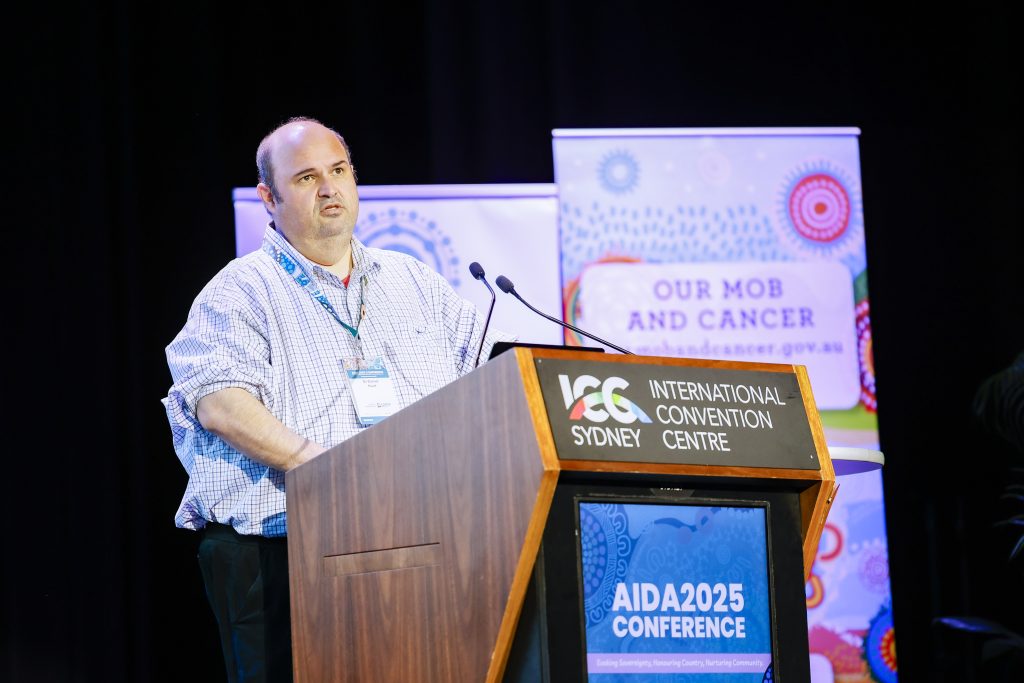
A different pathway into medicine
Dr Hunt’s journey into medicine did not follow a conventional path.
“I did not have great marks in high school, so I had to do a bridging program to get the appropriate marks to get into medicine,” he explains.
From there, he committed himself to the long road of training.
At one point, he stepped away from medicine to study dentistry, spending six years training and working in that field. Eventually, he realised his passion remained in medicine and returned to complete his training as a general practitioner.
“It’s just been a fantastic journey, and I do love every aspect of it,” he shares.
“My favourite part of being a doctor is the interaction with the patients, reassuring them and that we’re going to look after them.”
Breaking down barriers in healthcare
For Dr Hunt, becoming a doctor has always been about improving access and experiences for Aboriginal and Torres Strait Islander patients.
“Our patients can come in and know that they’re seeing an Aboriginal doctor,” he explains.
“That automatically brings the level down, makes the patient more comfortable and provides a level of personal interaction and really puts the patient at ease.”
He says patients often express how meaningful it is to receive care from an Aboriginal doctor.
“I see the difference in my patients when they are interacting, and they comment on it regularly; how wonderful it is to have an Aboriginal doctor looking after them.”
For Dr Hunt, that shared understanding plays a crucial role in delivering culturally safe care.
“It just breaks down that barrier because we do have a common history and a common lived experience.”
He believes culturally safe care is a fundamental part of providing the highest standard of medicine.
“Every patient accessing healthcare in Australia should be getting the gold standard,” he says.
“Not only are they getting everything that Western medicine can throw at them, but they’re also getting a culturally safe experience.”
Improving health outcomes
Throughout his career, Dr Hunt has led initiatives aimed at improving health outcomes for Aboriginal and Torres Strait Islander communities.
One program he is particularly proud of focused on improving the detection and treatment of syphilis through point-of-care testing at an Aboriginal medical service.
At the time, rising rates of syphilis were leading to preventable cases of congenital infection in newborns. Prior to the program, the service had experienced two infant deaths linked to transmission during pregnancy.
“Babies born with syphilishave increased mortality and mobidity,” he explains.
In response, Dr Hunt and his colleagues introduced on-site rapid testing, alongside education and immediate treatment pathways.
Over a four-year period, the program identified and treated 30 infectious cases, including 10 pregnant women, ensuring timely care and preventing transmission to their babies.
“So we essentially prevented 10 unnecessary deaths,” he says. “So that’s one thing I’m very, very proud of.”
A growing workforce
Dr Hunt says he is optimistic about the future of Aboriginal and Torres Strait Islander health and the growing number of doctors entering the profession.
“Only less than 30 years ago, we had zero Aboriginal doctors in Australia,” he says. “And now we have over 900 Aboriginal doctors in Australia.”
The growing Aboriginal and Torres Strait Islander health workforce reflects decades of work by health leaders, Communities and organisations supporting the next generation.
“Our networks are getting wider and stronger and the services are being strengthened by Aboriginal healthcare professionals across the board,” he shares.
For Dr Hunt, these changes represent real progress.
“It is a huge milestone and it’s an achievement that needs to be recognised.”
Community and recognition
In 2025, Dr Hunt was named NAIDOC Person of the Year and received the 2024 AIDA Doctor of the Year award, recognition he describes as both surprising and humbling.
“I feel still quite shocked by it, really,” he shares.
But for Dr Hunt, these honours represent more than individual achievement.
“It’s not really an individual prize or an award,” he says.
“It’s the cumulative effect of my Community, the people I work with and the people I’ve worked for.”
He says the recognition reflects the collective efforts of people committed to improving health outcomes for Aboriginal and Torres Strait Islander Communities.
“Any award that is received by our mob is an award for the people around them and the work that they do for the Community,” he reflects.
Missed previous Let’s Yarn! editions? Catch up:
Let’s Yarn! With Dr Justin Hunter
His pathway into medicine began decades earlier with a career as a medic in the Australian Defence Force.
Let’s Yarn! With Dr Marilyn Clarke
She is Australia’s first Aboriginal obstetrician and gynaecologist. Her journey into medicine began with a campus tour.
Let’s Yarn! With Dr Steph Trust
Dr Trust shares her journey from nursing to being awarded WA’s Rural GP of the Year in 2024.